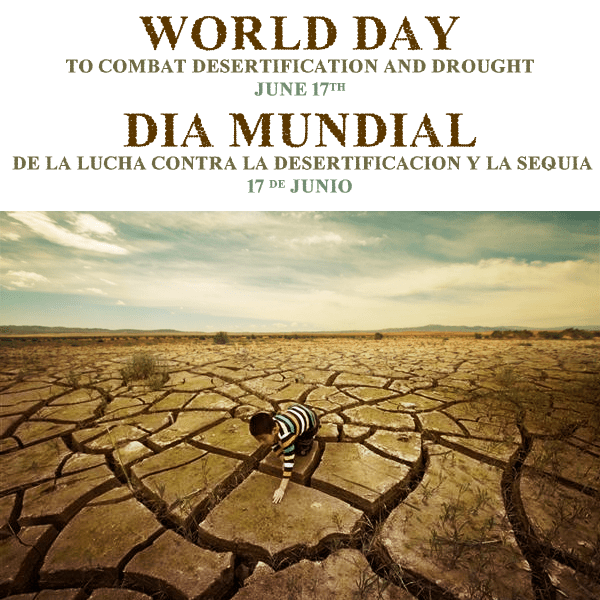
World Day to Combat Desertification and Drought, June 17th
Desertification is the process of land degradation (typically losing its bodies of water as well as vegetation and wildlife) in arid, semi-arid and sub-humid areas due to climatic variations and human activities.
Causes: Overgrazing is the major cause of desertification worldwide, urbanization, climate change, overdrafting of groundwater, deforestation, naturaldisasters and farmingpractices in agriculture are others that cause it.
One third of world’s land surface is threatened by desertification and across the world it affects livelihood of millions of people that needs what the lands used to provide.
Effects: No farming, hunger, floods, poor water quality, crowding and overpopulation, poverty.
Solutions: Policies related to how people can farm (how often, how much, what type) that can regulate and diminish desertification.
Educate people on sustainable practices will save more land from becoming desert.
We required technology to be created when it gets so difficult to avoid.
Wildlife, when they are in their real home they can help with the process of reforestation. They are not where they are just for no reason. We must respect their ecosystem. Years ago, some ecologists made a wrong decision in Africa and killed 40.000 thousand elephants as they thought they were triggering desertification and it went worse without them. Later, they realized about this mistake and repopulated lands facing desertification issues with thousands of animals in the correct ecosystem that helped improved the lands much more. You can see this on the following link: https://www.youtube.com/watch?v=vpTHi7O66pI
We can still save our lands, but we must act now.
Deforestation and Drought
Citation:
Rinkesh, ‘‘What is desertification?’’ www.conserve-energy-future.com/causes-effects-solutions-of-desertification.php. September 17th, 2015. Website June 16th, 2016
Collaborative Health
How Human-Influenced Animal Diseases Are Bad For All Of Us
Sickness and disease are an undeniable fact of nature. Animals and plants frequently sicken and die, sometimes in greater numbers than others. However, unless there is something seriously wrong with the ecosystem as a whole, sickness should not prove a major problem to biodiversity or population stability. Sickness and disease in wild plants and creatures may seem like one aspect of the environment which is beyond the direct control of humans. However, the alarming number of wildlife epidemics sweeping through the world at the moment has something very serious to say about the state of our planet in general. Unfortunately, humans cannot discount our own environmental impacts from the causes of this sad state of affairs. Nor should we be complacent about this. Humans, too, can be seriously affected by diseases which begin in the wild – and the gathering strength of several animal sicknesses could have major human implications if we do not begin to right the damages we have caused.
Wildlife Epidemics
The world is seeing entire species falling to a range of diseases on an unprecedented scale. Chytridiomycosis – which infects the skin of amphibians – is wiping out millions of the world’s frogs. The floors of American bat roosts are littered with the corpses of bats which have fallen prey to a new fungal disease known as ‘White Nose Syndrome’. A contagious facial cancer (a grouping of words which must strike fear into anyone’s heart) is killing Tasmanian devils. And in the UK, the stately ash trees which populate the decidious woods and ancient folklore of the island are succumbing in their thousands to a fungal infection known as Chalara dieback of ash. And this is only the tip of the iceberg. It would take pages and pages to detail all of the epidemics currently facing the world’s wildlife. Suffice it to say that the state of affairs is not good at all.
Human Implications
For the ecologically minded among us, this rise in wildlife diseases is a tragedy in its own right. But even those who are less inclined to care about the fates of plants and animals should be concerned. For not only are humans deeply implicated within the emergence of these diseases (more on that later), we are also threatened by them. Anyone who works with wild animals will be aware of the health precautions which must be taken in order to reduce the risk of cross-infection between human and animal. Humans are not immune to animal diseases – and, as animal pathogens and diseases proliferate and multiply, more and more of them are mutating in ways which allows them to infect humans. Indeed, it should be noted that some of our most fearsome epidemics have originated within the animal kingdom. The recent outbreak of Ebola in West Africa has been linked to the hunting of great apes (who also suffer from Ebola) and fruit bats. HIV/AIDS is believed to have passed to humans from chimpanzees. And let us not forget the bubonic plague, which killed an entire third of the human population in the fourteenth century. The ‘Black Death’ still lurks within rodent and flea populations. Given the right conditions, it could rise again.
Why Is This Happening?
Disease may appear to be something which is largely uncontrollable and un-influencable in wild situations. And it’s certainly true that once a virus or pathogen gains enough momentum to begin mutating and spreading exponentially then there is not a lot which can be done. However, humans could do with taking a closer look at the conditions which are allowing these illnesses to get out of control in the first place. Scientists are extremely concerned about the growing potential for animal illnesses to spread to human populations, and have made no bones about pointing the finger of blame firmly at human activity. It is humans who have forced alien species into close proximity with each other, resulting in the dangerous mixing and breeding of viruses and bacteria. It is humans who have warmed, deforested, and acidified the planet – creating fertile conditions in which pathogens find it easy to flourish and spread. It is humans who have destroyed wild habitats, bringing weakened and infected animals closer to human habitations. And it is humans who will ultimately suffer, unless something is done to halt the spread of pestilence in the wild.
One of the most wonderful aspects of experiencing nature and becoming immersed in the wilderness is its incredible healing capacity and ability to reconnect us with the natural world. For many of us, the pressures of our modern day society place us in an environment which is distanced from that essential time in nature we so badly need. Though urban development is helping our cities to become more “green” and “pedestrian”, we still lack that crucial time where all cell phones, tablets, and cars no longer await us around each corner – and we feel completely involved with the fauna and flora around us. Spending time in that coveted natural space is something that all of us need, whether it’s an afternoon in a national park, or an adventure in some of Costa Rica’s most magnificent, naturally diverse regions.
Ecotherapy
Costa Rica is designated as one of the planet’s most precious ecological treasures, with some of the world’s finest and most varied biodiversity. Passionate endeavors from the government, organizations, businesses and communities have seen that much of Costa Rica’s fragile wildlife remains untouched, while encouraging a friendly, conscientious tourism industry to flourish which offers visitors a once in a lifetime experience. Visiting such a wondrous environment is a dream many aspire to achieve, and it’s not just about seeing star attractions. It’s about experiencing the surrounding environment in ways which are fulfilling and memorable to the soul.
Costa Rica provides the perfect setting for this, and in a variety of ways. One of them is its potential as an ecotherapy escape. Ecotherapy is defined as “healing and growth nurtured by healthy interaction with the earth.” Recent years of studies have revealed that people who spend time in nature not only experience physical benefits (which subsequently have a positive impact on mental health as well) but also experience a greater peace of mind. This can occur on a small scale such as taking a ride through a park every day, or on a greater scale such as taking an environmentally-focused trip. “Green therapy” as it is also known has been proven to stimulate cognitive brain activity as well as help individuals who face mental health challenges.
The Greater Good
Certainly, Costa Rica provides a wealth of opportunities for people from all backgrounds to receive a healthy dose of ecotherapy. But it also enables – and empowers – individuals and groups to achieve something even more than that. By volunteering for a good cause, people not only spend time in a positive environment, but are also rewarded with a sense of fulfillment from working towards a conscientious project which has a positive impact on the ecosystem and the communities which flourish within it. For many people, it is projects such as this which can be a major turning point in their lives. People who have suffered from various struggles ranging from PTSD to substance abuse addiction have found purpose through helping others in a variety of ways, not only giving them responsibility but the knowledge that they are having a positive impact on someone else’s life. It is this very sense of purpose – as well as the support of the community – which makes volunteering such a poignant and powerful action. And ultimately, it is a step closer to finding an identity.
The learning experience which people undergo while volunteering on any project is immensely beneficial, not only for the technical skills learned but the personal journey. Meeting people who are like-minded but whose interests are diverse and finding support within that network can restore the sense of belonging that we all need, as well as the knowledge that every little contribution towards helping communities can accumulate to make a substantial difference.
Ecotherapy is more than simply a relaxing exercise in nature, but something which helps to fill an essential core part of our soul. Nature has always been a great muse on our personal journeys, and in turn, spending time in nature and working towards its protection and conservation is one way to give back. And there are myriad ways to do this, from volunteering at an ecotourist center, to campaigning online, raising funds for conservation efforts, planting trees, and helping wildlife recovery programs. Whatever the cause, one thing is clear – that being in nature and caring for its wellbeing is one of the best ways we can care for our ourselves.
Any visitors to Proyecto Asis will quickly become aware of one wonderful fact – Costa Rica has a truly incredible range of amazing wildlife. Costa Rica is incredibly lucky to have this rich biodiversity – and even luckier that the species it harbors are so very fascinating and appealing. Costa Rica is considered to have the highest biodiversity density of any country in the world, and most people rightly believe that this should be protected. However, this is not universally the case. Unscrupulous individuals are threatening not only the biodiversity of Costa Rica, but its entire ecosystem through the particularly loathsome crime of wildlife trafficking.
Serious Ecological Consequences
Costa Rica’s biodiversity is the pride of the world – but it also attracts plenty of less than savory individuals and cartels who want to use Costa Rica’s wildlife for their own gain. Wildlife trafficking – the removal of animals from the wild and selling them on – is a big problem for Costa Rica’s native species. While most international pet stores source their animals ethically and never take from the wild, there nonetheless exists a thriving black market in exotic animals, which is depleting Costa Rica’s natural stock considerably. Indeed, wildlife trafficking is thought to be the biggest threat to the Costa Rican ecosystem, after habitat depletion. This is very serious. If too many of any species is taken from the wild, the effects will reverberate right through the ecosystem, causing potentially catastrophic effects. As such, it is crucial to crack down on wildlife trafficking in Costa Rica before it is too late.
A Profitable Market
Wildlife trafficking is thought to be an incredibly lucrative worldwide industry. It follows drugs and weapons trafficking to come in as the third most lucrative form of smuggling, pipping human trafficking to the post. The ‘industry’ in its entirety is estimated to be worth an incredible $10 billion a year. It is these riches which undoubtedly attract the cruel individuals who participate in the actual trafficking itself. However, it is worth noting that the traffickers would very quickly go out of ‘business’ if no market for their wares existed. Many animals stolen from the wild in Costa Rica end up as household pets, and the demand for exotic, cute, and dangerous species for people to keep in their homes and show off to their friends is high. People always have been and always will be fascinated by animals – this is what makes zoos and wildlife documentaries such infallibly popular attractions. Costa Rica’s wealth of fauna makes it a prime target for wildlife smugglers, capturing such creatures for those who would possess them personally and exclusively. It would seem, therefore, that the best way to eliminate the trade is to eliminate the market.
The Turning Tide
This is where organizations like Proyecto Asis come in. Proyecto Asis helps to combat wildlife trafficking at a grassroots level by educating people about wildlife, and explaining why it’s best left in the wild. The project satiates people’s desires to get close to native Costa Rican fauna, while simultaneously discouraging them from the need to personally possess any such creatures. Initiatives like Proyecto Asis are, slowly, changing people’s opinions about wildlife, the environment, and how we interact in general with other species. This, in turn, is changing the world. Grassroots education about the environment can make a huge difference. The vacation industry, for example, once one of the least environmentally friendly businesses on the planet, is turning to ‘ecotourism’, because consumers – now wise in the ways of ecological science – are not only interested in the environment, but refuse to take a vacation that harms it. Indeed, in countries like the UK, people are choosing to go for ‘cheap and cheerful’ eco-vacations rather than splashing out on more expensive luxury tours, feeling that the environment is worth the drop in comfort. Ecotourism is particularly popular in Costa Rica, due in no small part to the influence of places like Proyecto Asis. If we can teach people to respect wildlife and its right to remain wild, then the bottom will eventually drop out of the trafficking industry, and millions of species will be saved.
Work Still To Do
However, there is a long way to go yet. A mere three months ago, Costa Rican officials deported a German tourist who was caught trying to smuggle over 400 reptiles and amphibians out of the country. The poor things were stuffed into takeout containers, and bound for exotic pet shops in Germany. Last year, a Canadian tourist was stopped at the airport with five live iguanas in her hand luggage, and in 2009, a man (German, again) attempted to board a plane with green parrots in his bag. These are only the colorful tales that make the news – many more animals are confiscated from passengers at customs every month, and countless more wild species are successfully smuggled from the country. Those who go on to buy the animals are probably unaware of their provenance, nor of the damage they are doing by funding the trafficking industry and providing a market for these creatures. If the issue is to be solved conclusively, we must raise awareness amongst ordinary people.
Every year, a group of students from Harper College in Chicago, comes to visit and volunteer with us Thank you amigos! It is wonderful to see you every year here at Proyecto Asis
Qué lindo que cada año tengamos nuevos estudiantes de Harper College visitando Proyecto Asis y haciendo voluntariado con nosotros ¡Nos vemos de nuevo en Agosto amigos!
Esta semana tuvimos el honor de recibir al Dr. John C Mather y su esposa. El Dr. Mather es Premio Nobel de Física 2006 por sus mediciones precisas de las micro ondas cósmicas. Actualmente es director en el laboratorio de cosmología en Nasa’s Goddard Space Flight Center.
This week Dr. John C Mather and his wife visited us. He is Nobel Prize in Physics, 2006, for his precise measurements of the cosmic microwave backgorund using the COBE satellite. Actually Mr. Mather is a Senior Astrophysicist in the Observational Cosmology Laboratory at NASA’s Goddard Space Flight Center.



You must be logged in to post a comment.